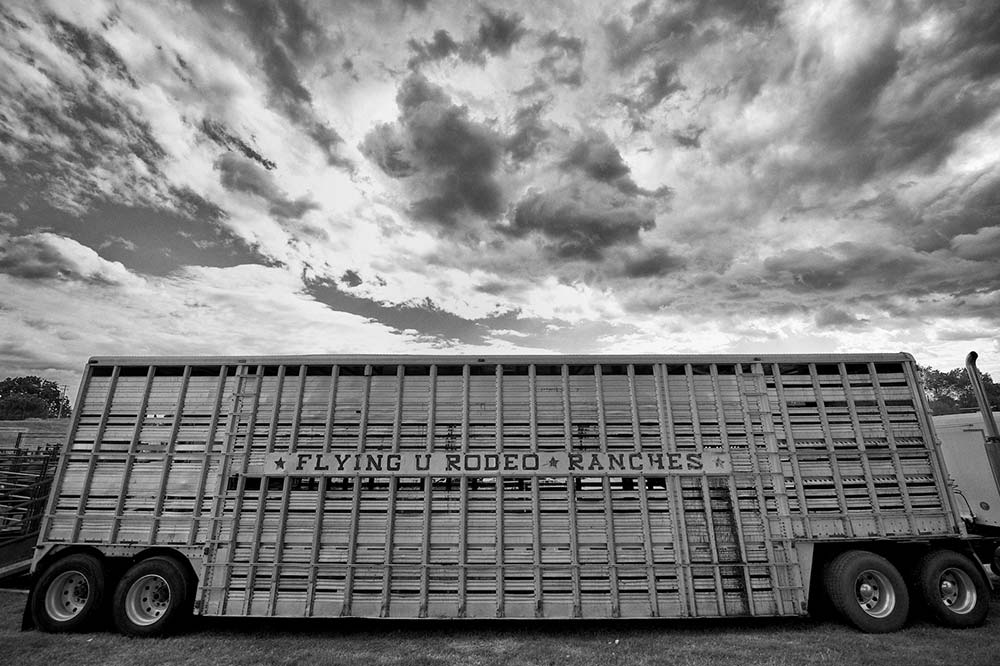
Ranches
matching their best bronc riders against
another ranches' bronc riders on the
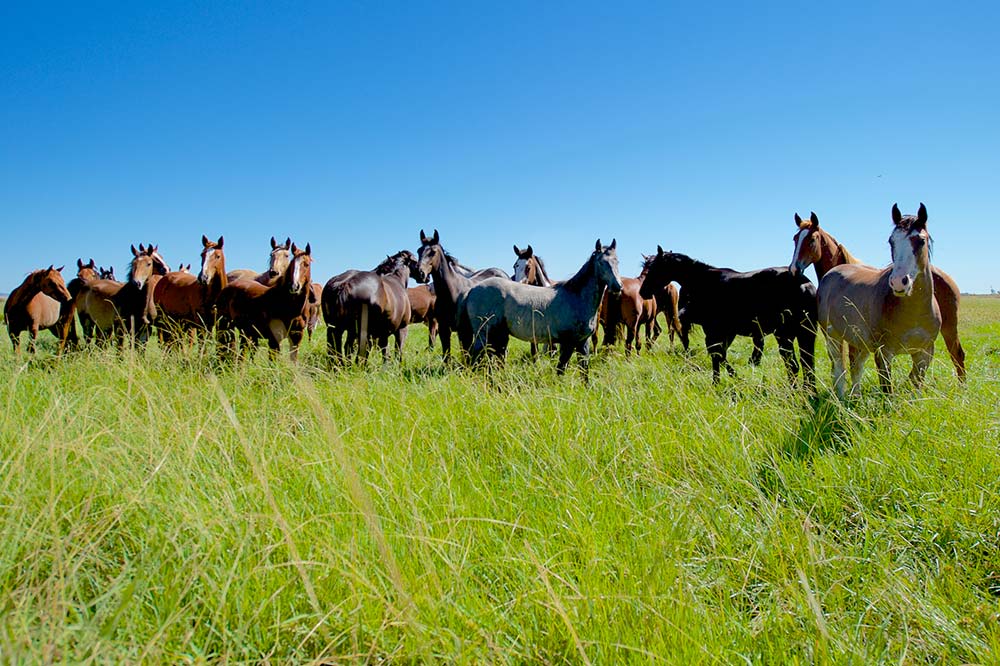
rankest horses they owned. Horses
were raised to be tough and last all
day long to work the big round-ups
of cattle. These horses dated
back to the wild mustang and the better
breeds brought over on ships from
Europe. The rodeo animals of
today are "BORN TO BUCK"
- it's in their blood. Great
animals don't come along as often
as one might think. These days,
there are selective breeding programs
throughout the United States and Canada.
Flying U has been raising bucking
horses since the late 1960's and the
bucking bull program, which was brought
about by Julio Moreno's interest in
the bull industry, began in the late
1980's. Julio oversees the breeding
of the stock, carefully choosing the
right cows to cross with the best
bucking bulls and the best bucking
mares to cross on the stallions.
The
bucking stock is the heart of a rodeo
stock contracting outfit. Flying
U Rodeo Co. - one of the oldest continuing
stock contracting companies in the
world - needs the backup of hundreds
of bucking horses and bulls throughout
the year-long rodeo season and raises
most all of their stock at their ranches
in Marysville, CA. A horse or
bull may only buck four to six times
a month, then will be turned out and
another group of stock will go on
the road. This means that each
animal works an average of only ten
minutes a year...what a life!
One
of Flying U's first bucking studs
was a mustang-type named "Tennessee
Stud", whose cross on "Harlem
Babe" - a good little mare that
came out of Watts (Los Angeles) -
was fantastic! She went on to
produce many great bucking horses
who eventually became Saddle Bronc
horses at the National Finals Rodeo.
The daughters of "Harlem Babe"
also gave birth to many of the red
roans still seen in the Flying U Bucking
string today.
There
have also been many great bucking
horses purchased by Flying U because
their owners could not handle them.
"Astronaut" was a bridle
horse gone sour who went on to compete
at the NFR. Another horse that
made many a trip to the NFR was "Cal
Expo", a former buggy horse who
found a good home at the ol' Flying
U. "Short Fuse", a
chunky little bay horse went on to
become Bareback Horse of the Year
in 1964. These kind of horses
don't come along very often, since
their rank parents were weeded out
of the herd and not bred back.
Athleticism and heart are the qualities
to look for in good bucking stock.
The
1981-82 Bareback Horse of the Year,
"Classic Velvet" was a dun
gelding with the pedigree of working
cow horse lines. And, while
his brothers and sisters made their
mark in the show ring, "Classic"
made his mark as one of the greatest
bareback horses of all times.
Hundreds of thousands of dollars were
won on this beautiful quarter horse
from Sonoma County, who came to the
Flying U after a group of cowboys
all tried to ride him and - in turn
- were all dusted! "Classic"
also had a brother who came to the
Flying U as a pick-up horse and ended
up an equine friend that the grandkids
learned to rope on.
Today,
Flying U boasts the likes of "Big
Chill", a grey thoroughbred gone
sour on the English show circuit.
"Big
Chill" has made a couple of trips
to the NFR and has the reputation
of being one of the strongest horses
in bareback riding, but is also so
gentle that you'd think you could
put a child up on his back.
The greatest mare in rodeo, "#363
Skoal Sally", is also a product
of the Born to Buck Program.
She has bucked off many a champion
cowboy and has also taken many to
80 or 90 point scores. The best
grey of all had to be "#39 Angel
Blue" - the 1985-89 Saddle Bronc
of the Year. This award was
voted on by fellow stock contractors
at the NFR, thus it is a very prestigious
and coveted honor. A saddle
bronc riders knew that if he drew
"Angel Blue" that he would
either be getting a paycheck or be
getting bucked off!
The
tough part about raising horses is
that it takes so long to find out
if you have a champion bucking horse.
The colts are not bucked until they
are almost four years old and they
may not prove themselves right away.
With younger, smaller riders, bulls
can begin being bucked at two years
of age. All of these young bucking
animals need to be brought along slow
and easy, as not to scare them the
first few times around. They
are brought to good arenas with excellent
footing for them to buck on, as well
as being put in well-maintained bucking
chutes and corrals.
The
Bucking Bull Program has come along
very well in the recent years.
Julio started with some roping heifers
and bred them to NFR bull "#9
Copenhagen One Eye" and "#74
Dodge Ram Tough" - a little black
bull with a lot of heart. Today,
their offspring heifers are being
crossed on "#97 Whitewater Skoal"
and "#H7 Typhoon" - both
great bulls with plenty of credentials.
"Whitewater Skoal" can be
seen on TNN when the PBR travels to
the West Coast for the Bud Light Cups.
"Typhoon" is now well over
ten years old and lives a good life
with a herd of cows.
Flying
U Rodeo is looking forward to the
future, when these young animals will
be the next stars of professional
rodeo!
Having
known Cotton since the 1940's, he
is one friend I know I can always
count on to be there for me. I have
known Cotton as a contestant, western
storeowner, rodeo producer, stock
contractor, trail rider, and friend
for over 60 years.
Cecil Jones
Rowell
Ranch Rodeo Director